
The same logo can look premium, playful or flat, depending on how it is applied. Choosing the finish is one of the biggest decisions for your drop. Here is how the four most common techniques work, what each one does best and where its limits are.
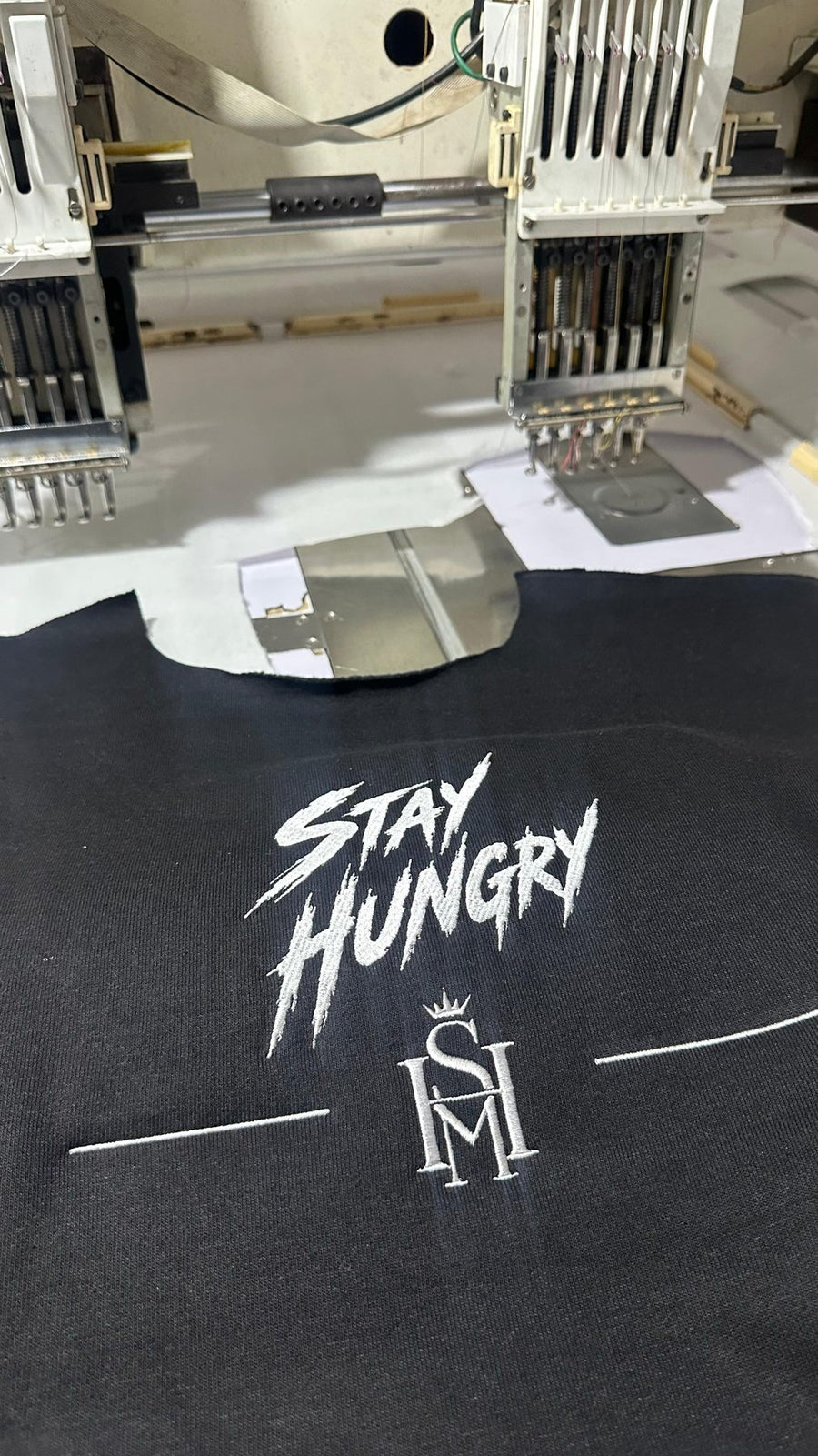
Embroidery
With embroidery, your design is stitched into the fabric with thread. First the artwork is digitised into a stitch file that tells the machine where every stitch goes. The result is textured, durable and looks premium.
- Best for: logos, lettering and small to medium designs on hoodies, sweats, polos and sets.
- Limits: very fine details, tiny text and colour gradients are hard to stitch. Very large areas get heavy and stiff.
3D embroidery, also called puff embroidery, adds a foam layer under the stitches, so the design stands out from the fabric. It works best on bold shapes and letters.
Screen print
Screen printing pushes ink through a fine mesh screen onto the garment. Every colour needs its own screen, and the colours are printed one after another.
- Best for: bold graphics with a few solid colours, strong and opaque colours on dark fabric, and larger quantities of the same design.
- Limits: every extra colour adds setup, so designs with many colours or photos get more complex. Gradients are possible with halftones, but not as smooth as a digital print.
Puff print
Puff print is a screen print with a special additive in the ink. When it is heated, the ink expands and creates a soft, raised 3D effect.
- Best for: bold logos and big letters that should stand out and make people want to touch them.
- Limits: because the ink rises, fine lines and small text lose sharpness. Keep the design simple and large enough.
DTF
DTF stands for direct to film. The design is printed digitally onto a special film, covered with an adhesive powder and then heat pressed onto the garment.
- Best for: colourful designs, fine details, gradients and photos, without extra setup for every colour.
- Limits: the print sits on top of the fabric as a thin layer, so it feels different from ink that goes into the fabric. For large areas, think about how it will feel to wear.
Rhinestones
Rhinestones are small crystals that are applied to the garment in the shape of your design. They catch the light and give a piece a statement look, from a small logo to a full design across a hoodie or a pair of sweatpants.
Comparison at a glance
| Finish | Look and feel | Fine details | Best for |
|---|---|---|---|
| Embroidery | Textured, premium | Medium | Logos, lettering |
| 3D embroidery | Raised, bold | Low | Big shapes and letters |
| Screen print | Smooth, solid colours | High | Graphics with few colours |
| Puff print | Soft, raised | Low | Bold logos and type |
| DTF | Thin layer, full colour | Very high | Colourful artwork, photos |
Which finish fits your design?
- A small logo on the chest of a heavyweight hoodie: embroidery or 3D embroidery.
- A big back graphic in one to three colours: screen print, or puff print for a raised look.
- Colourful artwork with fine details, or a photo: DTF.
- Something that should catch the light: rhinestones, from small logos to full designs.
You can also combine finishes on one piece, for example embroidery on the front and a print on the back. What is possible depends on your design, the fabric and the quantity, and we confirm it with your quote. Planning a heavyweight piece? Read GSM explained as well.
Which artwork files to send
- Vector files such as AI, PDF or SVG are ideal for embroidery, screen print and puff print.
- For DTF, a high-resolution PNG with a transparent background works well.
- Add the size in centimetres and the colours as Pantone codes.
Only have a sketch or a photo? Send it anyway. We tell you what we need and help you get the file ready.
Your next step
Send us your artwork and we suggest the finish that fits. Production starts from 30 pieces per style, and you see photos and video of your real order before it ships. More about our embroidery and print finishes.